Laser cutting is one of the most precise fabrication methods available, but the cut is rarely the final step. The intense heat involved in the process leaves behind edge defects that don't resolve themselves. These defects follow parts through every downstream operation. Heat-affected zones (HAZ), dross, and laser oxide layers on cutting edges are direct byproducts of laser cutting, and each creates measurable problems for coating, welding, assembly, and part longevity, which is why sourcing the right laser-cut parts deburring machine is crucial.
Understanding what causes these defects and how to address them efficiently is what separates shops that struggle with rework from those that run tight, consistent operations.
What Laser Cutting Does to Metal Edges
A laser beam cuts by melting and vaporizing material along a narrow kerf, using an assist gas to evacuate molten material from the cut zone. When nitrogen is used as the assist gas, the process runs oxidation-free. When oxygen is the cutting gas, a chemical reaction occurs between the oxygen and the hot metal, forming a hard oxide layer along the cutting edge. That layer is the source of several post-cut problems.
Heat-Affected Zones
The HAZ is the band of material immediately surrounding the cut that has been thermally altered without fully melting. Localized heating changes the metal's microstructure. Hardness increases in that zone, ductility decreases, and residual stress accumulates. For parts that undergo downstream bending or forming operations, a compromised HAZ can lead to cracking or inconsistent results. In stainless steel, thermal disruption near the cut edge also affects chromium distribution, increasing susceptibility to corrosion.
Dross
Dross is the resolidified molten material that clings to the bottom edge of a laser cut when the assist gas doesn't fully evacuate the melt pool. Cutting speed, laser power, material thickness, and gas pressure all influence how much dross forms and how firmly it adheres. Dross deposits are irregular, abrasive, and dimensionally imprecise. They pose a bonding failure risk for coatings and adhesives and create a safety hazard for anyone handling parts by hand.
Laser Oxide Layer
When cutting with oxygen, the cutting edges oxidize rapidly under the intense heat of the process. Although this oxide layer initially forms a thin surface barrier, it is not firmly bonded to the underlying metal. It can flake off under mechanical stress, vibration, or handling, taking any coating applied over it along with it. Before painting, powder coating, or welding, this layer must be removed entirely.
Why These Defects Compound Downstream
Left unaddressed, edge defects from laser cutting don't stay contained to the part's edge. Each downstream process introduces a new point of failure:
- Coating adhesion: Powder coat, liquid paint, and adhesives require a clean, chemically consistent surface. Oxide layers and dross deposits interfere with adhesion, leading to premature delamination and creating conditions for corrosion to develop beneath the coating.
- Weld quality: Oxide layers and burrs at weld joints create inconsistent fit-up, poor fusion, and porosity. Removing them before welding produces cleaner joints and reduces post-weld finishing time.
- Assembly fit-up: Burrs on holes and slots prevent parts from seating correctly in fixtures or mating assemblies. The result is either fit-up rejects or time-consuming manual rework that adds labor cost with no production value.
- Worker safety: Sharp laser-cut edges are a handling hazard throughout fabrication, shipping, and installation. Deburring and edge rounding eliminate injury risk and reduce liability.
- Neighboring part damage: When stacking or transporting parts with unaddressed burrs and sharp edges, can scratch adjacent parts, adding cosmetic defects that require additional finishing work.
That's why it's crucial to debur laser-cut parts. The cost of skipping this step almost always exceeds the cost of the process itself.
Mechanical Deburring Processes for Laser-Cut Parts
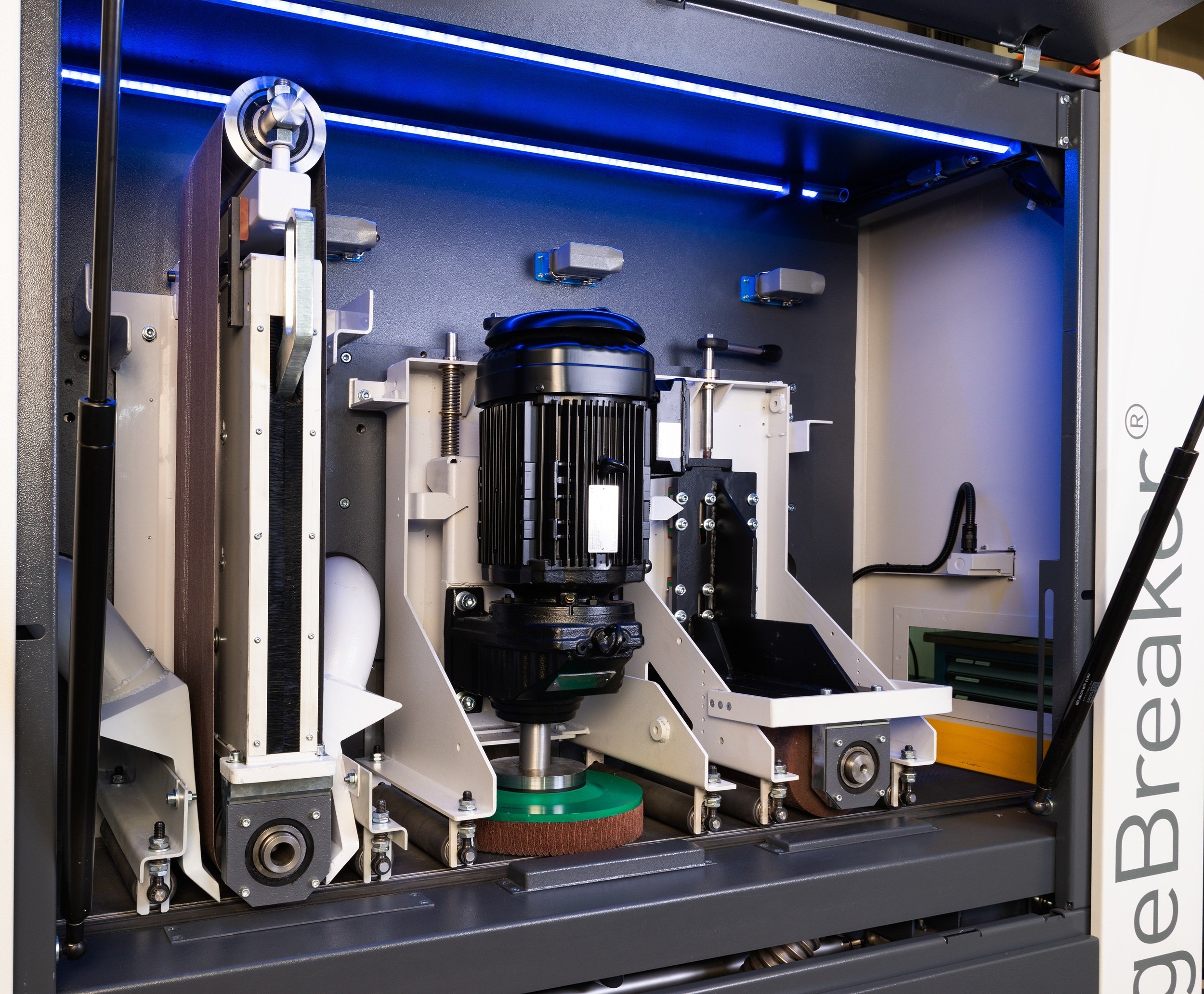
For flat sheet metal parts produced by laser cutting, mechanical deburring processes are the fastest and most repeatable option at production scale. Our EdgeBreaker® machines use several tool configurations, each suited to specific burr characteristics and production requirements.
Wide Belt Units
Wide belt deburring uses a grinding belt pressed onto sheet metal edges by a roller. The belts reliably remove burrs from laser cutting as the part passes through. Wide belt units are among the most commonly used deburring configurations for laser and punched parts, with abrasive belts available in numerous grits to control removal rate and surface finish. The EdgeBreaker® 6000, EdgeBreaker® 1000 and EdgeBreaker® 3000 FIBER use this method. With the EdgeBreaker® 3000 FIBER being very unique to the market as it uses wide belt units for deburring from both side (above and below) simultaneously.
Grinding Blocks
Grinding blocks process parts from above and below in a single pass, making them the right choice when parts cannot or should not be flipped. For operations that produce parts with burrs or spatters on both sides, double-sided processing in a single pass yields significant time savings. ARKU grinding blocks are available in zirconia alumina and ceramic versions in various grit sizes. The EdgeBreaker® 3000 NEXT and EdgeBreaker® 2000 NEXT use this configuration.
Grinding Drum
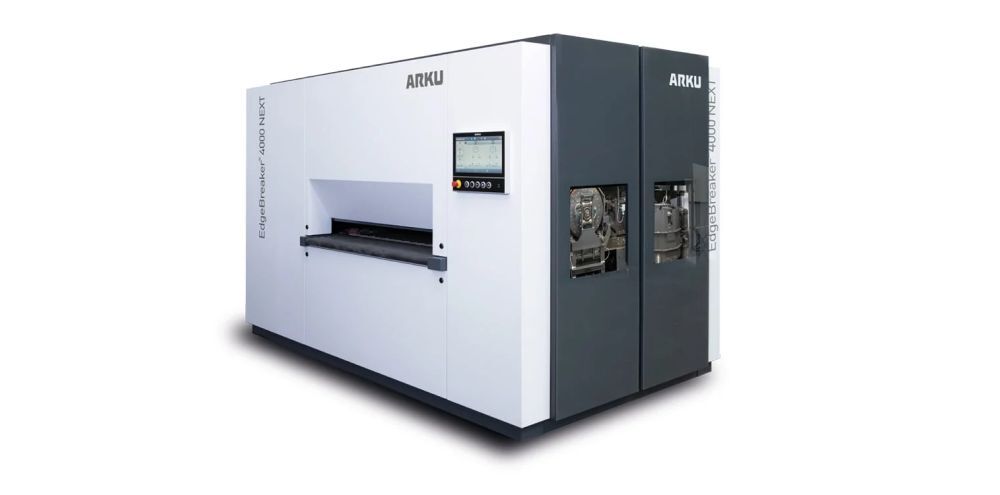
The grinding drum is the strongest deburring tool in the lineup. A drum covered with an abrasive belt presses against material edges from above, then rotates and oscillates to grind off burrs. Its large diameter allows for particularly aggressive abrasives, making it the preferred approach for heavier plate, stubborn burrs, and light slag. The EdgeBreaker® 4000 NEXT uses this method.
Laser Oxide Removal: A Separate but Connected Process
Deburring removes protruding burrs and dross. Oxide removal addresses the hard, flaky layer left on cutting edges by oxygen-assisted laser cutting. These are related but distinct problems, and both need attention before coating or welding.
Our EdgeBreaker® machines with laser oxide removal capability use steel wire roller brushes and steel wire blocks to strip the oxide layer from cutting edges. Steel wire roller brushes strike the edges from multiple directions, ensuring all sides of the part are clean. Steel wire blocks offer the added advantage of double-sided processing in a single pass, doubling the workable material thickness and significantly reducing processing costs.
The result is a clean, smooth cutting edge, ready for painting, powder coating, or welding, without the risk of oxide-related adhesion failure or paint cracking.
How To Choose the Right Deburring Machine for Your Operation
The right configuration depends on your material, part geometry, and production volume. Key selection factors include:
- Material type: Steel, stainless steel, aluminum, copper, brass, AHSS, and special alloys like tungsten all process effectively on ARKU machines. Abrasive selection should match material hardness and edge condition.
- Part thickness: The EdgeBreaker® lineup covers material thicknesses from 0.02" up to 5", depending on the model, addressing production requirements at both ends of the range.
- Burr character: Laser cutting typically produces small to medium burrs. Heavier burrs may call for a different deburring machine that focuses more on slag produced by plasma or oxyfuel cutting. Fiber laser cutting can also produce burrs that weld themselves onto the material due to extreme heat during cutting.
- Processing requirements: Some operations require only deburring. Others require deburring, edge rounding, oxide removal, and surface finishing in a single pass. Modern EdgeBreaker® machines can handle multiple processes simultaneously, reducing handling and cycle time.
- Working width: Working widths across the EdgeBreaker® range go up to 79", accommodating large sheet formats without multiple passes.
If your production volume or part mix makes in-house investment a longer-term decision, combining deburring with other inline processes keeps parts moving and reduces the cost per part over time.
Deburring Success With the Precision Tube Laser
Get the Edge Quality You Need
At ARKU, our EdgeBreaker® laser-cut parts deburring machines provide reliable, repeatable results across numerous materials. Whether you need to address dross or sharp edges before coating or assembly, we have the right machine configuration for your material thickness and production volume. Contact our team to discuss which solution fits your operation, or explore our full EdgeBreaker® lineup to compare models side by side.