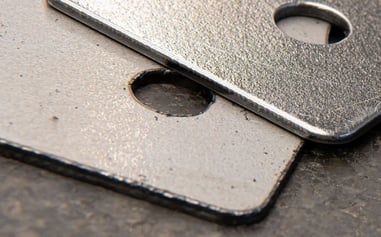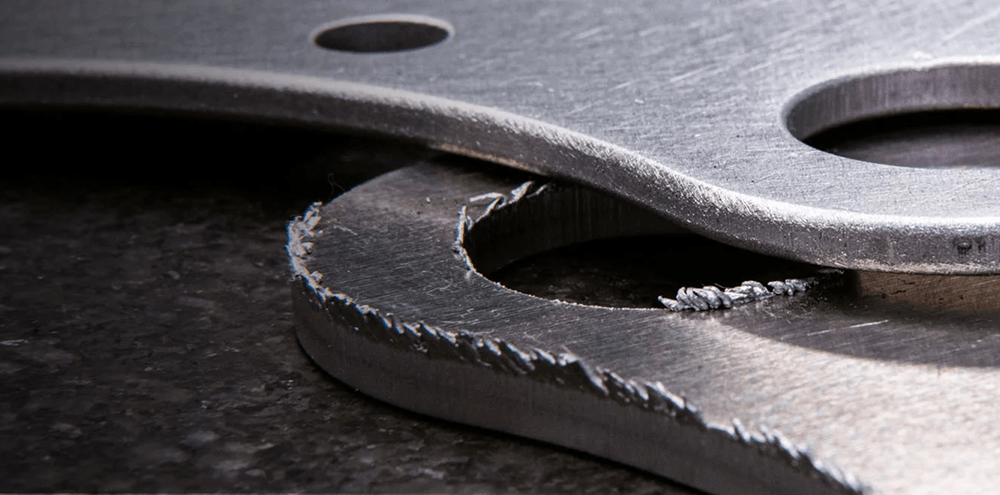
Every cutting operation leaves behind burrs. These small, unwanted ridges of material cling to edges after laser cutting, punching, and plasma or flame cutting. Left untreated, burrs create safety hazards for workers, cause assembly problems, and compromise the performance of finished components. That makes deburring one of the most critical steps in any metal fabrication workflow.
But not all deburring processes work the same way. The method you choose depends on your material, part geometry, production volume, and quality requirements. Selecting the wrong approach can inflate costs or produce inconsistent results.
In this article, we break down four of the most common deburring methods so you can determine which one best fits your application.
Manual Deburring
Manual deburring is the most straightforward approach. An operator uses hand tools like files, scrapers, abrasive pads, or deburring knives to physically remove burrs from each part. This method requires no specialized equipment, and operators can start immediately with minimal setup.
For low-volume jobs or one-off prototypes with simple geometries, manual deburring can be a practical choice. It also allows operators to focus on specific edges or hard-to-reach features that other methods might miss.
However, manual deburring has significant drawbacks that become more apparent as production volume increases:
- Inconsistency between parts: Results depend entirely on the operator's skill, pressure, and technique. Two workers deburring the same part can produce noticeably different edge finishes.
- High labor costs over time: What seems affordable for a handful of parts becomes expensive when applied to hundreds or thousands.
- Slow throughput: Each part requires individual handling, limiting how quickly your shop can move material through production.
- Ergonomic risk: Repetitive hand movements during manual deburring can lead to strain injuries, especially during long shifts.
Manual deburring makes sense when you need flexibility on a small batch. But once volumes climb or consistency becomes critical, it quickly becomes a bottleneck.
Mechanical Deburring
Mechanical deburring uses machines to remove burrs through physical contact with abrasives, brushes, or tumbling media. This category covers several distinct technologies, including vibratory finishing, tumble deburring, brushing systems, and wide-belt abrasive machines.
In vibratory finishing, parts are placed into a bowl or tub filled with abrasive media. The machine vibrates at a specific frequency, causing the media to scrub against part edges and surfaces. Tumble deburring works on a similar principle but rotates parts in a barrel instead. Both methods handle large quantities of smaller parts at once.
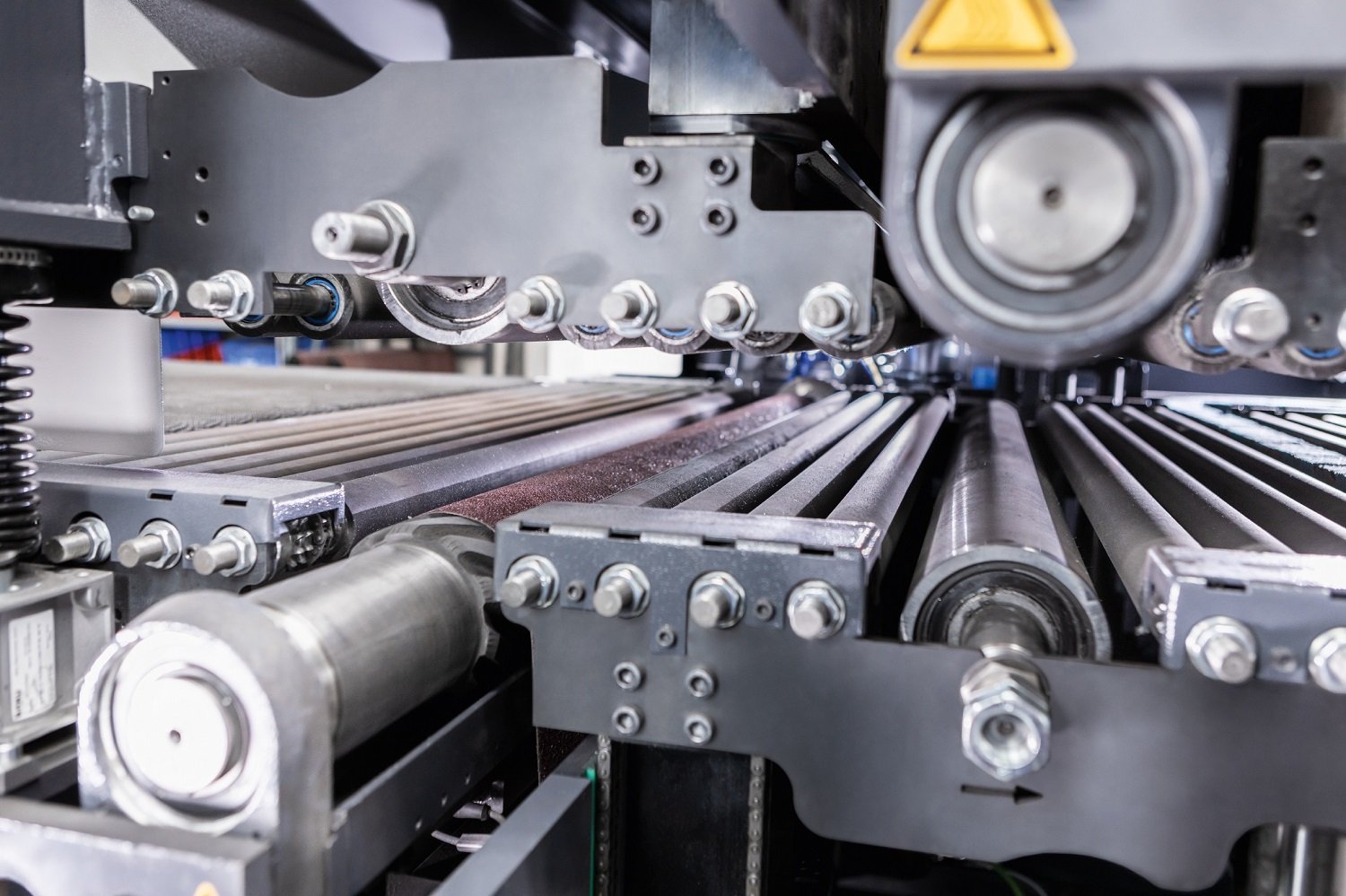
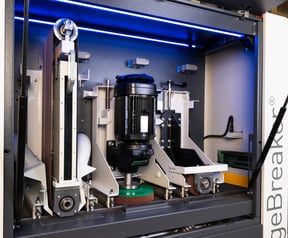
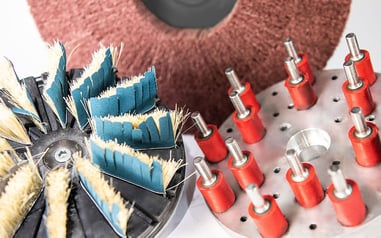
Brushing systems use rotating wire or abrasive-loaded brushes to target specific edges. Wide-belt deburring machines pass sheet metal parts through multiple processing stations equipped with abrasive belts, brushes, and finishing tools. These machines can deburr, round edges, and finish surfaces in a single pass.
Here are the key advantages of mechanical deburring:
- Repeatability: Machines produce consistent results part after part, eliminating the variability of hand finishing.
- Scalability: Mechanical systems handle high-volume production runs efficiently, reducing per-part costs as volume increases.
- Multi-step processing: Advanced deburring machines can perform deburring, edge rounding, oxide removal, and surface finishing in one operation.
- Reduced labor dependency: Operators load and unload parts, but the machine handles processing, freeing your team for other tasks. Our material handling systems simplify the process even further.
The trade-offs include higher upfront equipment costs and the need for initial setup and tool selection. For vibratory and tumble systems, cycle times can be lengthy depending on part size and material. And not every part geometry is suited for every mechanical method. Thin or delicate parts, for example, may require gentler processing approaches.
Mechanical deburring machines are the go-to choice for shops that process sheet metal at medium to high volumes and need reliable, repeatable edge quality across every part.
Thermal Deburring
Thermal deburring, also known as the Thermal Energy Method (TEM), takes an entirely different approach. Instead of physically grinding or scrubbing burrs away, this process uses a controlled combustion reaction to burn them off.
Here's how it works: parts are loaded into a sealed, heavy-walled chamber. A precise mixture of fuel gas and oxygen fills the chamber, and a spark plug ignites it. The resulting combustion wave reaches temperatures between 2,500°C and 3,300°C, but it lasts for only about 20 milliseconds. During that brief flash, burrs reach their auto-ignition point and oxidize completely. The mass of the part itself acts as a heat sink, so the base material stays unharmed.
This process excels in specific situations:
- Internal burrs: Because the gas fills every cavity, TEM can remove burrs from blind holes, intersecting cross-holes, and other internal features that no tool or brush can physically reach.
- Complex geometries: Parts with dozens of features across multiple surfaces are uniformly deburred in a single cycle.
- High-volume production: Cycle times typically run under two minutes, and operators can batch multiple parts in a single chamber load.
Thermal deburring does have limitations. It leaves behind an oxide residue that requires a follow-up cleaning step. The process cannot round edges or produce a specific surface finish. Very thin-walled or fragile parts may not tolerate the combustion event. And the equipment requires strict safety protocols due to the pressurized gases involved.
TEM works best for machined components where internal burr removal is the priority and where parts are made from steel, cast iron, aluminum, brass, or certain thermoplastics.
Electrochemical Deburring
Electrochemical deburring (ECD) uses electrical current and a conductive salt solution to dissolve burrs through a controlled chemical reaction. Think of it as reverse electroplating: instead of adding material to a surface, the process removes it.
In practice, a specially shaped cathode (the tool) is positioned near the burred area of the workpiece (the anode). An electrolyte solution flows between the two, and when direct current is applied, the metal at the burr dissolves into the electrolyte as metal hydroxide particles. The process typically runs for 10 to 30 seconds per cycle.
Because the cathode never physically contacts the workpiece, ECD produces no mechanical stress, no heat-affected zones, and no secondary burrs.
Electrochemical deburring is particularly well suited for:
- Precision components in hydraulic systems, fuel injection systems, and aerospace assemblies, where burr-free intersecting passages are critical
- Hard-to-reach internal edges at the intersection of drilled holes deep within a workpiece
- High-repeatability production where every part must meet identical edge specifications
The challenges with ECD include the need for custom-designed cathode tooling for each part geometry, the requirement that workpiece materials be electrically conductive, and the ongoing management of electrolyte solutions. Initial setup costs can be substantial, but per-part costs drop significantly at higher volumes.
How To Choose the Right Deburring Process
No single deburring process is ideal for every application. The right choice depends on a combination of factors specific to your parts and your production environment.
| Factor | Manual | Mechanical | Thermal | Electro- thermal |
| Best production volume | Low | Medium to high | High | Medium to high |
| Part complexity | Simple | Varies by method | Complex internal features | Precision internal features |
| Edge rounding capability | Limited | Yes | No | Limited |
| Consistency | Operator-dependent | High | High | Very high |
| Internal burr removal | Poor | Limited | Excellent | Excellent |
| Setup cost | Low | Moderate to high | High | High |
| Per-part cost at volume | High | Low | Very low | Low |
For sheet metal fabricators working with laser-cut, punched, or plasma-cut parts, mechanical deburring typically offers the strongest combination of speed, consistency, and flexibility. Manual methods still have a place for very small runs, while TEM and ECD serve niche but critical roles in the finishing of machined components.
The ARKU EdgeBreaker 3000 FIBER
Get an up-close view of our ARKU EdgeBreaker® 3000 and experience how its powerful abrasive belts reliably remove fiber burrs.
Get the Edge Quality Your Parts Demand
At ARKU, we design deburring machines that eliminate variability and labor intensity in sheet metal edge processing. We offer machines that handle deburring, edge rounding, oxide removal, and surface finishing in a single automated pass. Contact our team to discuss your application and find the right machine for your production requirements.
Frequently Asked Questions
How does part thickness affect which deburring process you should use?
Thin sheet metal parts under 1 mm are sensitive to aggressive processing. Thermal deburring can warp or damage thin-walled components because the combustion event concentrates heat in areas with less mass. Electrochemical deburring can also thin edges beyond tolerance on very fine parts. For thin sheet metal, mechanical deburring with properly selected abrasives and controlled contact pressure gives you the most predictable results without risking part distortion.
Can you combine multiple deburring methods on the same part?
Yes, and many manufacturers do. A common example involves using thermal deburring to clear internal burrs from cross-drilled holes, followed by mechanical deburring to round external edges and produce a specific surface finish. Each method addresses a different feature of the part. The key is sequencing the operations so that earlier steps do not create new issues for later ones.
What role does material type play in selecting a deburring process?
Material properties significantly influence process selection. Aluminum, for instance, can melt and splatter during thermal deburring if burrs are too large, making process control critical. Stainless steel resists oxidation, which can reduce TEM effectiveness on that alloy. Electrochemical deburring requires electrically conductive materials, so it cannot process plastics or ceramics. For mechanical deburring, the abrasive grit type must match the material hardness to avoid premature wear or surface damage.
How do you measure and verify deburring quality?
Most manufacturers rely on a combination of visual inspection (often with magnification), tactile checks, and, in some cases, optical profilometry or coordinate measuring machines (CMM). Industry standards like ISO 13715 define how edge conditions should be specified on engineering drawings using symbols that indicate permissible burr height or required edge rounding radius. For safety-critical applications in aerospace or medical devices, inspection protocols may require 100% verification of every deburred feature on every part.